
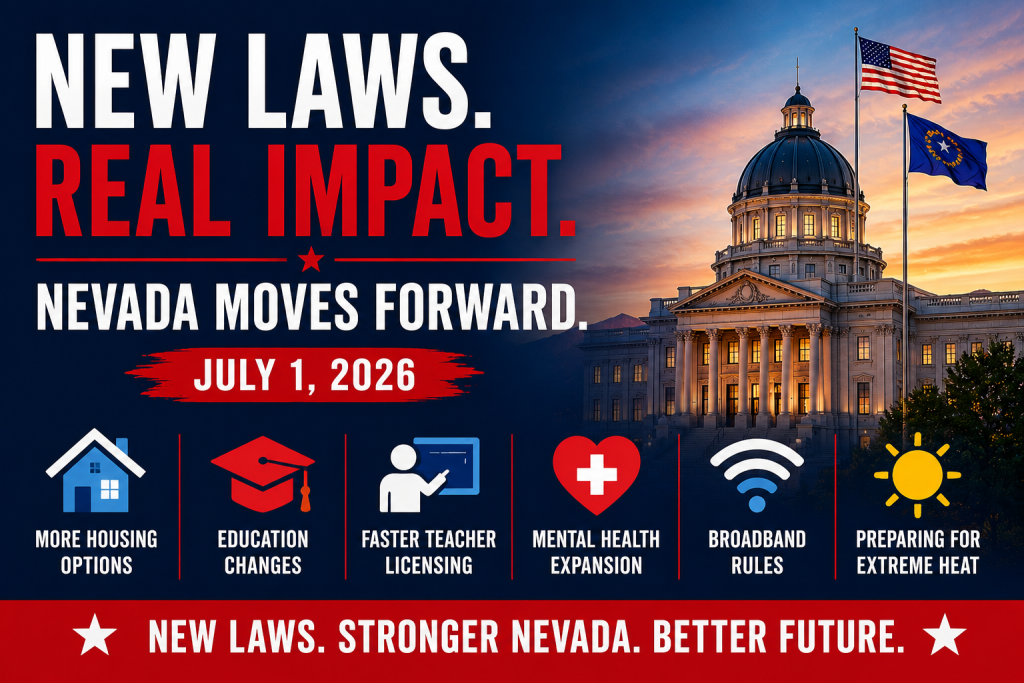
July 1, 2026
Today marks the beginning of a new chapter in Nevada law.
More than two dozen laws approved during the 2025 legislative session officially take effect on July 1, bringing changes that will impact homeowners, students, teachers, patients, internet providers, and communities across the state.
Some of these laws received broad bipartisan support. Others sparked debate. Regardless of where Nevadans stand politically, these changes are now part of everyday life.
Here are some of the most significant new laws and what they mean.
More Housing Options for Homeowners
One of the biggest changes affects homeowners in Clark and Washoe counties.
Under Assembly Bill 396, many property owners will now have greater ability to build accessory dwelling units (ADUs), often called casitas, backyard cottages, garage apartments, or in-law suites.
The law establishes statewide standards limiting how local governments can restrict these units while also updating how homeowners associations may regulate them.
Supporters argue the change will increase housing availability and create additional income opportunities for homeowners.
Critics worry the law could gradually change neighborhood density and reduce local control over zoning decisions
Schools Will Limit Student Cellphone Use
Beginning this school year, Nevada school districts must implement new policies limiting cellphone and electronic device use during the school day.
Each district must create clear rules governing when devices may be used and establish progressive disciplinary procedures for repeated violations.
Exceptions remain for emergencies, teacher-approved instruction, disability accommodations, and individualized education plans.
The goal is straightforward: reduce classroom distractions while still allowing flexibility when technology serves an educational purpose.
Expanded School Choice
Another education law expands opportunities for students to attend schools outside their assigned attendance zones.
If space is available, families may apply to transfer their children to another public school within the district.
Districts must publicly list available seats and cannot base acceptance on academic performance, disability status, extracurricular participation, or home address.
The state is also providing transportation funding to help qualifying families access schools outside their neighborhoods.
Supporters view the law as another step toward increasing educational choice for Nevada families.
Faster Teacher Licensing
Nevada is also attempting to address teacher shortages.
Teachers licensed in other states may now begin working under provisional one-year licenses while completing Nevada’s licensing process, provided they pass background checks and meet application requirements.
The law also expands pathways for educators entering career and technical education, counseling, nursing, and social work.
State leaders hope these changes will make it easier to recruit qualified professionals into Nevada classrooms.
Mental Health Care Expands
Several new laws focus on behavioral and mental health.
Nevada is creating a new category of licensed residential mental health facilities designed to provide structured, around-the-clock treatment outside traditional hospitals.
The state is also creating a new behavioral health and wellness practitioner license focused on prevention and early intervention.
If federal approval is granted, Medicaid will begin covering many of these new services.
Lawmakers also approved funding to expand Nevada’s behavioral health workforce through scholarships and higher education programs.
Broadband Infrastructure Gets New Rules
As internet infrastructure continues expanding throughout Nevada, broadband providers will now face additional requirements before installing equipment in public rights-of-way.
Companies must negotiate agreements with local governments, while cities and counties must apply those rules equally to all providers.
The legislation also establishes limits on local access fees.
Supporters believe the law creates clearer expectations for both local governments and broadband companies while encouraging continued infrastructure investment.
Southern Nevada Must Prepare for Extreme Heat
Recognizing Nevada’s growing heat challenges, lawmakers approved a measure requiring Clark and Washoe counties to include heat mitigation planning in future development plans.
Communities will now be expected to consider:
- Additional public cooling centers
- Improved drinking water access
- Shade expansion
- Drought-tolerant landscaping
- Cooler building and pavement practices
As temperatures continue reaching record highs during the summer months, supporters say planning for extreme heat has become a public safety necessity rather than simply an environmental issue.
What These Laws Say About Nevada
Taken together, this year’s new laws reflect several priorities emerging from Carson City:
- Expanding housing opportunities
- Increasing educational flexibility
- Addressing teacher shortages
- Improving access to mental health care
- Investing in infrastructure
- Preparing communities for extreme heat
Some Nevadans will welcome these changes.
Others may question whether lawmakers struck the right balance between statewide standards and local control.
That debate is likely to continue well beyond today.
But regardless of political perspective, these laws are now in effect—and they will shape how Nevada grows, educates students, delivers healthcare, and plans for the future.
For voters, it’s another reminder that legislative sessions don’t end when lawmakers leave Carson City.
The decisions made there eventually become part of everyday life for every Nevadan.
All 24 bills in effect as of July 1st 2026
Revises provisions relating to the Statewide Substance Use Response Working Group. (BDR 40-442)
Revises provisions relating to educational personnel. (BDR 34-519)
Revises provisions relating to certain behavioral health services. (BDR 39-434)
Revises provisions relating to public employees. (BDR 53-160)
Revises provisions relating to master plans. (BDR 22-397)
Revises provisions relating to the inspection of meat and poultry. (BDR 51-154)
Revises provisions relating to the judiciary. (BDR 38-155)
Revises provisions relating to education. (BDR 34-97)
Revises provisions relating to housing. (BDR 22-232)
Revises provisions relating to grants. (BDR 31-589)
Revises provisions relating to the access of public rights-of-way by broadband providers. (BDR 58-664)
Makes revisions relating to mental health care. (BDR 38-350)
Revises provisions relating to education. (BDR 34-756)
Makes appropriations to the Department of Veterans Services for certain vehicles and equipment. (BDR S-1192)
Makes appropriations to the Department of Corrections for various purposes relating to certain technology, training and equipment. (BDR S-1204)
Revises provisions relating to health care. (BDR 54-38)
Establishes provisions relating to behavioral health. (BDR 54-145)
Revises provisions relating to industrial insurance. (BDR 53-632)
Revises provisions governing the treatment of certain military credentials in the licensure and hiring of educational personnel. (BDR 34-663)
Revises provisions relating to caseworkers of agencies which provide child welfare services. (BDR 38-710)
Revises provisions relating to education. (BDR 34-108)
Revises provisions concerning policies governing the use of certain electronic devices in schools. (BDR 34-855)
Revises provisions relating to education. (BDR 34-16)
Makes appropriations to and authorizes the expenditure of money by the Department of Education for the replacement of computer hardware and associated software and office chairs. (BDR S-1193)