
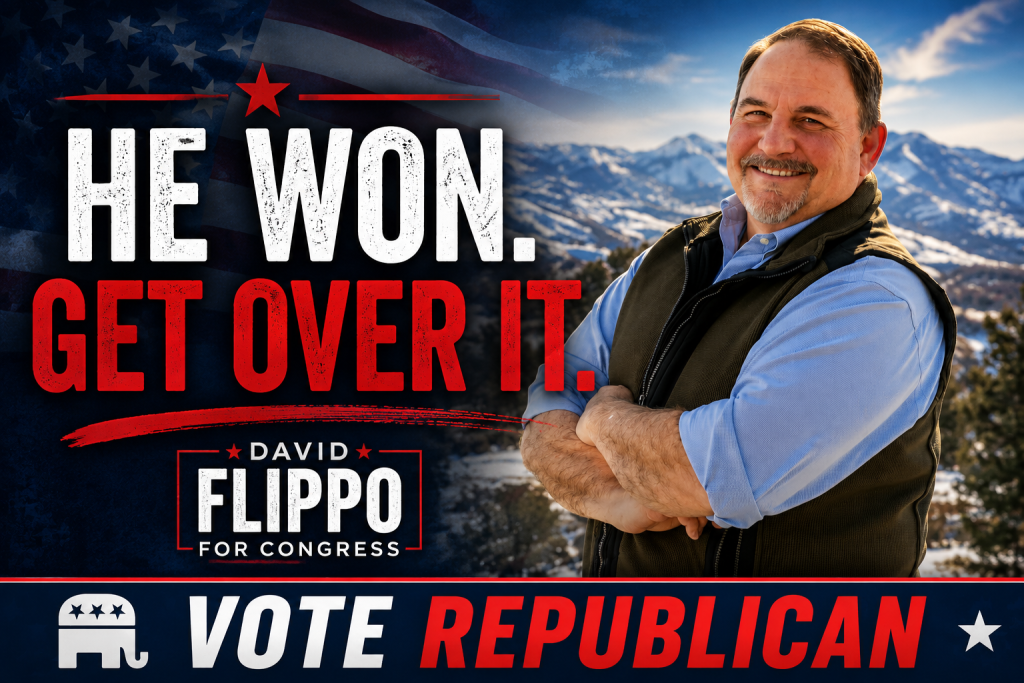
Some say David Flippo only won because of President Trump’s endorsement. Others insist he must now reinvent himself into former State Senator James Settelmeyer if he hopes to win in November. Still others suggest Republican leaders rallying behind Flippo somehow reflects panic rather than unity.
The facts tell a different story.
David Flippo didn’t stumble into victory. He built a campaign that understood where Republican voters are today—not where political insiders wished they still were.
For months, conventional wisdom declared Flippo couldn’t win. James Settelmeyer entered the race with nearly every advantage imaginable: decades in elected office, deep relationships throughout Northern Nevada, endorsements from Governor Joe Lombardo, Congressman Mark Amodei, and much of the Republican establishment.
Yet Republican primary voters rejected conventional wisdom.
Flippo didn’t just squeak by. He won convincingly, carrying ten of the district’s twelve counties and finishing with a double-digit victory. Those results weren’t an accident. They were the product of an aggressive field operation, sophisticated voter targeting, coalition building, and relentless voter contact. Even campaign professionals writing after the election described the effort as one of the most data-driven Republican campaigns Nevada has seen in years.
The Nevada Independent—hardly a publication known for cheerleading conservative candidates—reported that Flippo’s campaign knocked on approximately 30,000 doors, made roughly 75,000 phone calls, invested heavily in voter modeling, and ultimately achieved near-universal name recognition among Republican primary voters. By Election Day, voters knew exactly who David Flippo was—and they chose him anyway.
President Trump’s endorsement unquestionably mattered. It likely sealed the race. But endorsements don’t manufacture campaigns out of thin air. They amplify candidates who have already built momentum. Flippo’s organization spent months assembling endorsements from veterans, grassroots activists, conservative organizations, county officials, and national America First leaders before the President ever weighed in.
Just as important, the campaign embraced a modern communications strategy, pairing sophisticated digital targeting with professionally produced videos, high-quality graphics, consistent branding, and an online presence that rivaled top-tier statewide campaigns—reaching voters where they actually consume information today rather than relying solely on traditional campaign tactics.
Some commentators now argue Flippo must become “James Settelmeyer 2.0” to succeed in the general election. That argument ignores reality. Throughout the campaign, Flippo consistently spoke about Northern Nevada’s water rights, mining, energy production, federal land management, ranching, and the rising cost of living—issues that matter deeply to the district’s voters. Those priorities were never exclusive to one candidate.
Others point to Republican leaders such as Robin Titus, PK O’Neill, and Governor Lombardo rallying behind Flippo after the primary as evidence of concern. A far simpler explanation exists: the primary is over.
Healthy political parties unite behind the nominee their voters selected. That isn’t weakness. That’s how representative government is supposed to work.
Perhaps the greatest lesson from this election isn’t about David Flippo at all.
It’s about Republican voters.
For years, political insiders assumed endorsements, résumés, and institutional support would determine nominations. This race demonstrated something different. Republican voters wanted an outsider with military leadership, conservative convictions, and a willingness to challenge the status quo. Whether everyone in Carson City or Washington approved simply wasn’t the deciding factor.
Some analysts are still searching for complicated explanations.
Nevada Republicans already gave a very simple one.
They voted.