
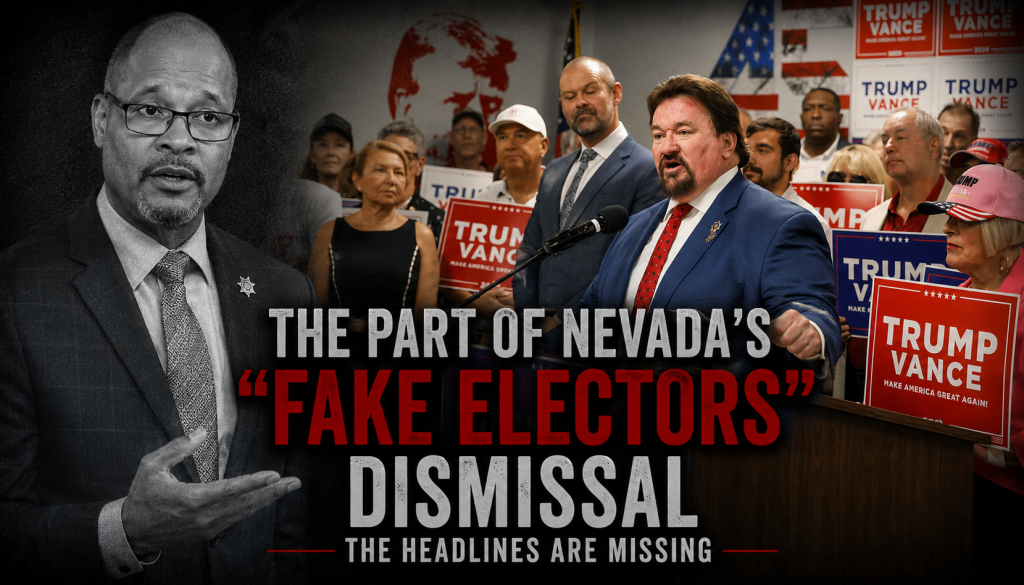
If you read most of the headlines about Nevada’s so-called “fake electors” case today, you will learn that the case was dismissed.
You will probably also learn that Attorney General Aaron Ford intends to appeal.
What you may not learn, and what Nevadans absolutely deserve to know, is why Judge Mary Kay Holthus dismissed it.
This was not simply another procedural setback. It was not merely another argument over where the attorney general should have filed the case.
The court found a fundamental problem with the state’s prosecution: the evidence presented to the grand jury did not establish the fraudulent intent necessary to support the charges, and the attorney general’s office failed to present exculpatory evidence to the grand jury.
That distinction matters.
The case has always depended heavily on intent. The State’s theory was that Nevada’s Republican electors intended their documents to be accepted as legitimate electoral votes and thereby deceive government officials.
Judge Holthus found the evidence did not reasonably support that conclusion.
In her order, she pointed to something remarkably straightforward: the defendants weren’t exactly hiding what they were doing.
As Judge Holthus wrote:
“The fact that Defendants openly announced both their actions and their asserted purpose, rather than concealing their conduct or attempting to secretly induce governmental reliance, weighs against a reasonable inference that they acted with fraudulent intent.”
That is devastating to the theory underlying this prosecution.
But the problem goes further.
The court also determined that the State failed to disclose exculpatory evidence to the grand jury.
Think about what that means.
A grand jury hears the case largely through the prosecution. There is no traditional adversarial trial occurring in that room where defense attorneys can stand up, cross-examine witnesses and immediately challenge the State’s characterization of the evidence.
That makes the prosecutor’s obligation to fairly handle material evidence particularly important.
Yet according to the court, evidence favorable to the defendants, evidence relevant to the central question of whether they actually intended to commit fraud, was not presented.
That should be one of the biggest facts in every story about this dismissal.
Instead, much of the coverage reduces the development to another chapter in the national “fake elector” storyline: six Republicans were charged, a judge dismissed the case, and Ford plans to appeal.
That framing misses the most important part of the ruling.
A judge looked at what the Attorney General’s office actually presented and concluded that the evidence was insufficient to establish the required fraudulent intent — while also finding that exculpatory evidence had been withheld from the grand jury.
Those findings should matter regardless of someone’s politics or feelings about the 2020 election.
Due process is not supposed to become optional because prosecutors believe their targets are unpopular.
And that brings us to Attorney General Ford’s announced appeal.
The Attorney General now wants to devote even more public resources to appealing a prosecution that has already been dismissed twice — this time after a judge found insufficient evidence of fraudulent intent and concluded that his office failed to present exculpatory evidence to the grand jury.
The Attorney General’s office already spent years pursuing this prosecution. The first case was dismissed in 2024 over venue. Ford appealed that ruling and ultimately persuaded the Nevada Supreme Court to return the case to Clark County.
Now the case has been dismissed again — this time on grounds that strike much closer to the substance of the prosecution itself.
And Ford wants another appeal.
Why?
An appellate court can review whether Judge Holthus applied the law correctly. But an appeal does not magically create evidence of fraudulent intent that the district court found lacking. Nor does announcing another appeal erase the court’s finding concerning the State’s failure to present exculpatory evidence.
There is also an uncomfortable political reality that deserves acknowledgment.
Aaron Ford isn’t merely Nevada’s attorney general anymore. He is a candidate for governor.
That makes transparency about this prosecution even more important. Nevadans deserve to know whether continuing this litigation serves a legitimate law-enforcement purpose or whether an extraordinarily high-profile prosecution has simply become too politically valuable to abandon.
There is another point the headlines frequently obscure.
The six Republicans did not conduct their actions in some secret room. The elector ceremony was conducted publicly outside the Nevada Legislature. It was filmed. Their actions and stated purpose were openly discussed.
That fact does not automatically determine whether their conduct was lawful. But when the crime alleged requires fraudulent intent, it becomes enormously relevant.
Judge Holthus recognized that.
The State apparently wanted the grand jury to infer a secret intention to deceive government officials while confronting evidence showing the defendants publicly announced what they were doing and why they said they were doing it.
The court wasn’t persuaded.
Neither should Nevadans be satisfied with news coverage that reports the dismissal without explaining those findings.
People are free to believe the Republican electors were wrong. They are free to believe their actions after the 2020 election were irresponsible, misguided or politically motivated.
But criminal prosecution requires something more than believing someone’s conduct was wrong.
The government has to prove the elements of a crime.
And when the government asks a grand jury to indict citizens for felonies, it does not get to selectively present a version of events while omitting exculpatory evidence.
That isn’t a Republican principle.
It isn’t a Democratic principle.
It is a basic principle of a justice system that is supposed to care as much about how it obtains a conviction as whether it obtains one.
So yes, the Nevada “fake electors” case was dismissed.
But that isn’t the whole story.
The more important story is why.
The court found insufficient evidence of fraudulent intent. It found that the defendants’ open conduct weighed against an inference that they intended to secretly deceive the government. And it found that the Attorney General’s office failed to present exculpatory evidence to the grand jury.
Those facts belong in the headline, not buried beneath it.
And before Attorney General Ford spends another round of taxpayer money appealing this case, perhaps he should first explain to Nevadans how his office ended up withholding evidence the court believed the grand jury should have heard.
After years of litigation, two dismissals, and now a judicial finding raising serious questions about how this prosecution was presented to the grand jury, another appeal doesn’t look like persistence.
It looks like an inability to admit when a prosecution has failed.