April 21, 2026
Every election season, candidates promise they’re fighting for “the people.” Then the campaign finance reports come out.
Nevada’s latest fundraising filings offer more than just dollar amounts—they provide a glimpse into who believes certain candidates are worth investing in and which interests are hoping to shape the next legislative session.
Money doesn’t automatically buy votes. It doesn’t guarantee influence. But campaign contributions can reveal priorities, alliances, and the networks surrounding those seeking public office.
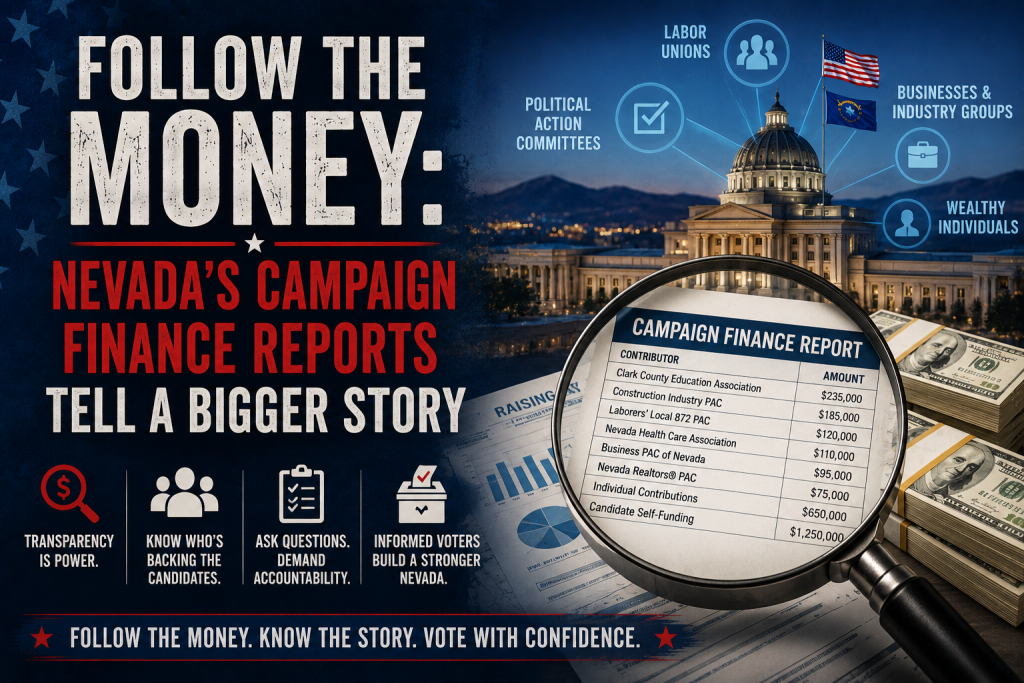
This year’s reports show millions of dollars flowing into Nevada campaigns from labor organizations, political action committees, businesses, industry groups, and wealthy individuals willing to write large checks—or even bankroll their own campaigns.
None of that is illegal. Most of it is perfectly routine.
The question Nevada voters should ask is much simpler: Who is each candidate most accountable to once Election Day is over?
One of the most striking examples comes from organized labor.
Campaign finance reports show the Clark County Education Association and affiliated political committees directing hundreds of thousands of dollars into legislative PACs. Construction unions also invested heavily in legislative races, particularly where lawmakers opposed or supported major policy proposals such as the expansion of Nevada’s film tax credits.
That’s politics.
Groups that care deeply about an issue have every right to support candidates who share their views. Business organizations do it. Labor unions do it. Industry associations do it. Advocacy groups do it.
But voters deserve to know exactly who’s writing the checks.
Transparency allows Nevadans to connect the dots between campaign support and future policy decisions.
The reports also demonstrate another growing trend: self-funded campaigns.
Several candidates loaned hundreds of thousands—or even millions—of dollars to their own campaigns. Personal wealth has become an increasingly common way to launch a competitive campaign, especially in expensive media markets.
While self-funding can free candidates from relying on donors, it also raises another question: Does financial advantage make it harder for grassroots candidates to compete?
Ultimately, elections should be decided by ideas and leadership—not simply by who can afford the most television commercials.
Perhaps the most encouraging part of Nevada’s campaign finance system is that every voter has access to these records.
Campaign finance reports are public for a reason.
They allow citizens—not political insiders—to evaluate the financial support behind every campaign and make informed decisions at the ballot box.
Regardless of party, candidates should welcome that scrutiny.
If they’re proud of the people and organizations standing behind them, transparency should never be a concern.
For conservatives, this has long been a core principle: government works best when it operates in the open, and accountability begins with information.
Campaign finance reports don’t tell voters how they should cast their ballots.
But they do remind us of something important.
In politics, it’s always worth following the money—not to assume corruption, but to better understand the coalitions, priorities, and interests competing to shape Nevada’s future.
An informed voter is a stronger voter. And in a representative republic, transparency remains one of the best protections the public has.