
OPINION / ANALYSIS
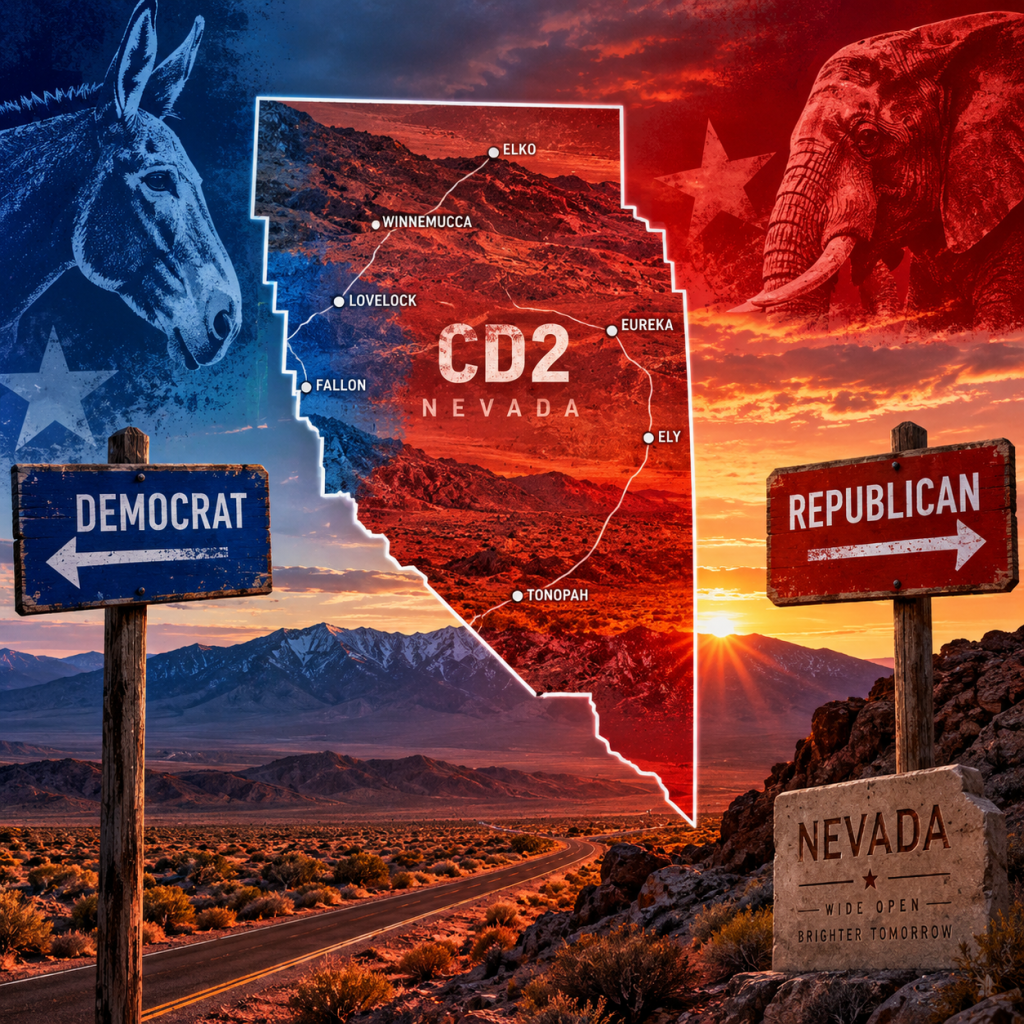
Nevada Current reported Tuesday that Nevada’s 2nd Congressional District may be more competitive than in recent cycles, citing Democrat Teresa Benitez-Thompson’s second-quarter fundraising, Republican David Flippo’s residency history, former Rep. Mark Amodei’s refusal to endorse him and broader national political conditions.
The race is plainly worth more attention than a routine “safe seat” story would suggest. But the available evidence still supports a narrower conclusion: CD2 may be more competitive than usual without yet looking like a true toss-up.
The race ratings still point in the same direction
The Current notes that The Cook Political Report and Sabato’s Crystal Ball continue to rate the district Solid Republican. Inside Elections has moved it to Lean Republican, a meaningful difference, but still a rating that assigns Republicans the advantage.
Ratings can change, and none is a prediction carved in stone. But they remain useful because they incorporate more than one campaign headline: district partisanship, candidate performance, national environment, fundraising and available polling.
That makes it important to separate “more competitive” from “competitive enough to be called a toss-up.” At the moment, those are not the same claim.
The Current highlights that Benitez-Thompson raised slightly more than Flippo during the second quarter. That is a legitimate signal of campaign viability. It is not the entire financial picture.
According to the Federal Election Commission, Benitez-Thompson reported $257,086.52 in total receipts through June 30 and ended the period with $140,607.07 cash on hand.
Flippo’s FEC profile shows $2.27 million in total receipts over the 2025-2026 cycle and $117,882.89 cash on hand as of June 30. That larger total also comes with an important qualifier: roughly $1.645 million came from loans made by the candidate, and the committee reported more than $1.6 million in debt.
So the cleanest reading is not that either side has an overwhelming financial advantage. Benitez-Thompson held a modest cash-on-hand edge at the end of June, while Flippo has self-financed at a much larger scale.
Primary divisions are real, but so is post-primary consolidation
Amodei’s decision not to endorse Flippo after backing James Settelmeyer in the primary is politically notable. The Current also reports, however, that Gov. Joe Lombardo endorsed Flippo after supporting Settelmeyer during the primary and that Senate Minority Leader Robin Titus has backed Flippo as well.
That does not erase Republican divisions. It does show that the post-primary picture is mixed rather than one-directional.
Primary endorsements often reveal personal and factional preferences. General-election endorsements tend to reflect a broader comparison between the parties. Treating one set of endorsements as decisive while minimizing the other would give readers an incomplete picture.
The Current’s story focuses heavily on Flippo’s vulnerabilities. A full general-election analysis also has to account for Benitez-Thompson’s years in the Nevada Legislature.
Her record includes service on the Assembly Taxation Committee and votes on major fiscal and economic-policy questions. That record gives the Republican campaign material to scrutinize, just as Democrats will scrutinize Flippo’s residency history, campaign financing and primary relationships.
That is where the race is likely to become more substantive: not simply in whether one candidate is “interesting” or whether a seat has historically been safe, but in how each candidate’s record and policy positions fit the district.
There is a strong case that CD2 deserves more attention in 2026 than it has in some previous cycles. Benitez-Thompson has shown she can raise money. Flippo emerged from a contested Republican primary with lingering intraparty friction. At least one major race-rating outlet has moved the seat toward the center.
There is also strong evidence that the district still begins with a Republican advantage. Two major forecasters cited by the Current still rate it Solid Republican, and the broader party coalition around Flippo has not collapsed.
The most accurate description, then, may be the least dramatic one: CD2 is worth watching, but the burden of proof still rests on anyone arguing that its underlying political fundamentals have fundamentally changed.
That could happen. It has not been demonstrated yet.
Sources: Nevada Current, Sept. 8, 2026; Federal Election Commission — Teresa Benitez-Thompson; Federal Election Commission — David Flippo.