OPINION
The federal government’s election fight with Nevada just escalated.
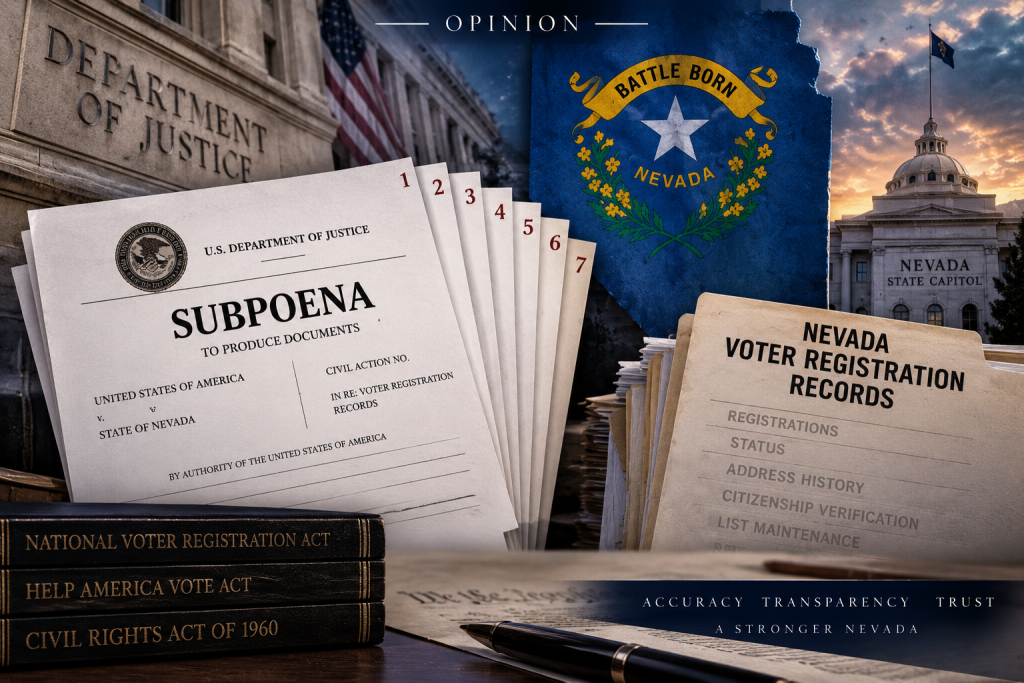
FOX5 reported late Monday that the U.S. Department of Justice has served seven subpoenas on Nevada Secretary of State Cisco Aguilar seeking voter information ahead of the November election. The subpoenas come after months of federal pressure over Nevada’s voter rolls and after the Justice Department sued Nevada in December 2025 for failing to produce the statewide voter-registration list it had requested.
This is significant. But a subpoena is not proof of fraud, and a government denial is not proof that everything is fine.
Nevadans should demand something more useful from both sides: show the evidence.
The federal government has raised specific concerns
This dispute did not begin this week.
In December 2025, the Justice Department announced a lawsuit against Nevada and several other states over access to statewide voter-registration lists. DOJ says federal law gives the attorney general authority to inspect records necessary to enforce the National Voter Registration Act, the Help America Vote Act and the Civil Rights Act of 1960.
Then, this summer, the Department of Homeland Security raised an even more serious allegation. According to reporting by The Nevada Independent, DHS told Nevada officials that it had identified 8,576 voter registrants whose identifying information matched people listed as noncitizens in federal records. Federal officials suggested the total number of potentially problematic registrations could exceed 15,000.
Those are not numbers that should be waved away because the source is the Trump administration.
If federal agencies possess reliable records showing that ineligible noncitizens are registered to vote in Nevada, state election officials should examine those records promptly and transparently.
But there is an equally important word in that sentence: reliable.
A database match is not the same as an ineligible voter
Secretary of State Cisco Aguilar has called the federal figures “wildly speculative” and said the state had not been given enough underlying information to validate the claims.
That objection deserves to be taken seriously too.
Large government databases contain errors, outdated citizenship information, duplicate names and mismatched records. A person who was once recorded as a noncitizen can later become a naturalized American citizen. Similar names and dates of birth can also create false matches.
No eligible Nevada voter should lose his or her registration because a computer generated a questionable match.
Aguilar’s stated standard — that officials should have high confidence in a person’s ineligibility before taking away voting rights — is reasonable. The state’s responsibility, however, cannot end with saying the federal government is wrong.
If Nevada believes thousands of federal matches are unreliable, demonstrate why.
Nevada should not treat transparency as a partisan demand
Election administration becomes less credible when every request for records is treated as an attack and every irregularity is treated as proof of a conspiracy.
Nevada has already seen a substantial shift in its registration rolls this summer. More than 50,000 voters moved out of active status statewide in August as part of routine list maintenance. That does not mean those voters were illegally purged, just as the federal government’s latest subpoenas do not mean thousands of illegal votes have been discovered.
These are different issues. They share one lesson: the public deserves precise explanations instead of partisan shorthand.
The Secretary of State’s Office should comply with lawful requests for election records while protecting confidential voter information and challenging demands that exceed federal authority. The Justice Department, meanwhile, should provide Nevada with enough underlying data to permit genuine verification rather than simply announcing alarming totals.
There is an easy way to build public confidence
Once the legal questions surrounding the subpoenas are resolved, Nevada officials should publicly report the results of the verification process in aggregate form.
How many of the federal matches involved actual noncitizens?
How many were already naturalized citizens?
How many registrations were outdated or duplicated?
How many, if any, records resulted in lawful removal?
And most importantly: how many of the people identified by federal agencies actually cast a ballot while ineligible?
Those answers would do more for election confidence than another round of dueling press releases.
Investigate first. Conclude second.
Republicans should not need to assume every federal allegation is already proven in order to support serious voter-roll verification. Democrats should not need to assume every federal inquiry is voter suppression in order to defend eligible voters.
There is a straightforward standard Nevada can apply.
Every eligible citizen should be able to vote. No ineligible person should remain on the rolls. And government officials making claims about either should be prepared to prove them.
Seven federal subpoenas make this more than another political talking point. They represent a real escalation in a dispute that has been building for months, and Nevadans deserve to know what the records actually show.
Not what Washington says they show.
Not what Carson City says they show.
What the evidence shows.
Sources: FOX5 Las Vegas, Sept. 7–8, 2026; U.S. Department of Justice, Dec. 12, 2025; The Nevada Independent reporting on DHS voter-registration allegations, July 2026.