
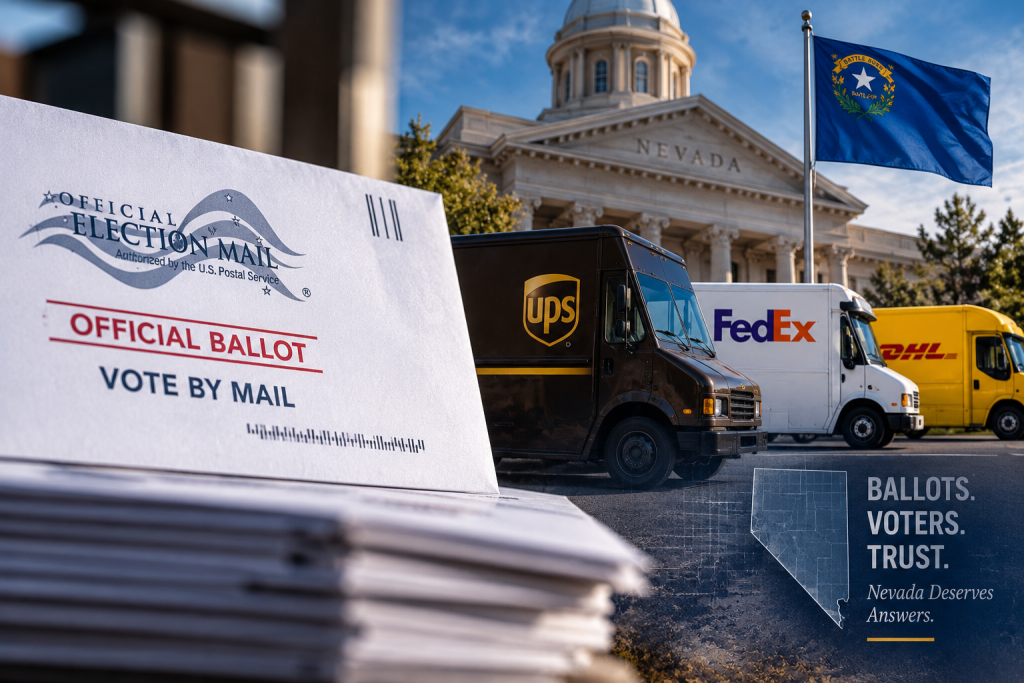
Nevada’s election officials should plan for contingencies. But when the contingency involves putting official ballots into the hands of private carriers, “we’re crisis managers” is not enough of a legal explanation.
The Nevada Independent reported September 8 that Secretary of State Cisco Aguilar’s office has been researching whether private carriers could help deliver mail ballots this fall amid concerns about disruption at the U.S. Postal Service. According to the report, the office contacted FedEx, UPS and DHL; Aguilar said the state could not work with FedEx because the company is not unionized, and the office received a cost quote from UPS.
There is a legitimate reason to prepare for problems. Election administrators do not get to shrug if ballots are delayed, mail service deteriorates or federal-state disputes threaten the normal election calendar. Nevada sends a mail ballot to essentially every active registered voter who has not opted out, so distribution is not a side issue. It is core election infrastructure.
But contingency planning has to begin with the law.
Nevada’s statutes were written around the mail system we actually use
Nevada law is full of provisions built around ordinary postal delivery. NRS 293.269911 says return envelopes for domestic voters must include postage prepaid by first-class mail. NRS 293.269921 says a returned mail ballot generally must be postmarked by Election Day and received by the fourth day after the election. State regulations go even further: county clerks determine the mailing date from a physical postmark or barcode information applied by the United States Postal Service.
Those provisions primarily govern the return of ballots, not necessarily every conceivable method a county could use to get an outgoing ballot into a voter’s hands. That distinction matters. It would be irresponsible to claim that Nevada law plainly forbids every private-carrier option when the legal question is more complicated than that.
But it would be equally irresponsible for the state to move toward an unprecedented delivery system without first explaining exactly where its authority comes from and how every downstream election rule would still work.
Before any contract is signed, Nevada deserves answers
If UPS or another private carrier is being seriously considered for outbound ballot delivery, the Secretary of State should publicly answer a few basic questions.
What statutory authority permits the change? Would counties need to enter separate contracts, or would the state act for them? How would undeliverable ballots be handled when Nevada law requires outgoing ballot envelopes not to be forwarded? Would private-carrier tracking information become an election record? What chain-of-custody standards would apply? Would voters in rural Nevada, tribal communities, apartment complexes and areas without normal residential delivery receive equivalent service? And what would the change cost taxpayers statewide?
Most importantly, officials should make crystal clear that any change in outbound delivery does not quietly alter the legal rules for returning ballots. Nevada’s current postmark framework is tied directly to USPS markings. Voters cannot be left wondering whether a UPS label, a private tracking scan or some other timestamp suddenly counts as an Election Day postmark.
That is not a hypothetical paperwork concern. In a close election, the validity of a ballot received after Election Day can turn on the date the ballot entered the mail stream. The rules have to be knowable before voting begins, not reconstructed afterward in litigation.
Contingency planning should reduce uncertainty, not create more of it
Aguilar is right about one thing: election officials have to anticipate failure points. The state should have backup plans for delayed mail, cyberattacks, natural disasters, equipment failures and other disruptions that could interfere with voting.
But a backup plan is only useful if it is lawful, operationally tested and publicly understood.
Nevada has spent years arguing that confidence in elections depends on clear procedures and consistent administration. That standard does not disappear because the threat now comes from possible postal disruption rather than a disputed voting machine or a lawsuit over voter rolls.
If private delivery is merely one idea on a whiteboard, say so. If it is a serious option, release the legal analysis, logistics plan and cost estimate before implementation. If existing law is too rigid to accommodate a genuine emergency, then the Legislature should fix the law rather than asking election administrators to improvise around it.
Nevadans should not have to choose between reliable ballot delivery and clear election rules. A competent system can provide both.
Sources: The Nevada Independent, Sept. 8, 2026; Nevada Revised Statutes, Chapter 293; Nevada Administrative Code, Chapter 293.