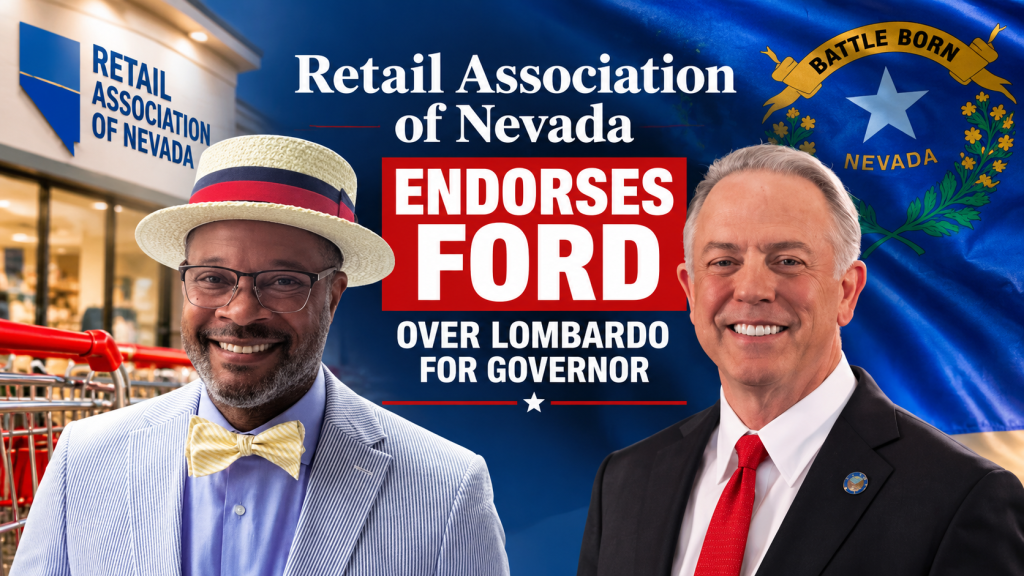
The Retail Association of Nevada has made an unusual choice in the governor’s race.
The organization endorsed Democratic Attorney General Aaron Ford over Republican Gov. Joe Lombardo.
That is newsworthy on its own.
According to association president Bryan Wachter, the organization does not always endorse gubernatorial candidates, and the last Democrat it backed for governor was Bob Miller, who left office in 1999.
But the endorsement deserves more examination than simply adding another name to Ford’s endorsement list.
Why did a retail organization that has historically not gravitated toward Democratic gubernatorial candidates make this decision?
The answer appears to involve several issues, and separating them matters.
Tariffs are prominent among them.
Firefly restaurant owner John Simmons appeared at the endorsement announcement and described higher costs facing his business. He blamed tariffs for increasing prices and argued that international tensions are also hurting tourism.
That concern is hardly unique to one Nevada restaurant.
Businesses dependent upon imported products can face higher costs when tariffs increase the price of those goods. Nevada’s tourism economy can also be affected by broader national and international economic conditions.
But there is an obvious jurisdictional problem in turning that concern into an argument about Nevada’s governor.
Federal tariffs are federal policy.
Joe Lombardo cannot impose them.
He cannot repeal them.
Aaron Ford could not repeal them as governor either.
Ford’s argument is different. He says Lombardo should use his position to challenge President Donald Trump more aggressively when federal policies hurt Nevada businesses.
Voters can decide whether they find that argument persuasive.
But the distinction should remain clear.
The policy itself originates in Washington, not Carson City.
There is a second component of the Retail Association’s decision that may be considerably more relevant to state government.
Wachter pointed to a proposed Nevada State Board of Pharmacy regulation that would limit the number of prescriptions pharmacists may fill each day.
He argued that such a restriction could contribute to pharmacy closures and make it harder for Nevadans to obtain medication.
That criticism presents an interesting challenge to Lombardo’s record.
The governor has made regulatory reform a central part of his economic message. His campaign says the administration has eliminated or streamlined more than 900 regulations.
If an agency operating within Nevada government is simultaneously considering a rule that retailers believe would substantially increase their costs or restrict services, it is reasonable to ask how those two things fit together.
But responsibility needs to be established rather than assumed.
What authority does Lombardo have over the Pharmacy Board?
Who proposed the regulation?
What evidence supports the 250-prescription limit?
What problem is the board attempting to solve?
And what evidence supports the Retail Association’s warning that the regulation could contribute to pharmacy closures?
Those are questions Nevada policymakers should answer before turning the issue into a campaign talking point.
The endorsement also needs perspective.
The Retail Association of Nevada is a business organization.
It is not the Nevada business community.
Lombardo retains endorsements from several other prominent business groups.
The Vegas Chamber has endorsed him.
So has the Asian Chamber of Commerce.
The Lombardo campaign says the Latin Chamber also supports his reelection.
The Asian Chamber’s president described Lombardo in August as a trusted partner to Nevada businesses and praised his administration’s approach to entrepreneurship and economic development.
That creates a much more complicated picture than “business abandons Lombardo.”
Some business organizations prefer Lombardo.
The Retail Association now prefers Ford.
The useful question is why.
Part of the answer may lie in the industries each organization represents.
Retailers experience tariffs differently from construction companies, professional-service firms or technology businesses.
Restaurants experience international tourism differently from companies primarily serving Nevada residents.
Pharmacies face regulations that many other businesses never encounter.
An endorsement can therefore reveal something important about the economic pressures facing a particular industry without demonstrating a statewide political realignment.
Ford also used the announcement to attack Lombardo’s veto record, pointing to legislation involving prescription drugs, school meals and corporate ownership of housing.
Those policies deserve examination on their own merits.
A bill being described as lowering costs does not establish that it would actually lower costs.
Likewise, a governor vetoing legislation does not establish that the underlying problem does not exist.
Nevadans deserve to know what each proposal would do, what it would cost and what unintended consequences might follow.
Lombardo’s campaign responded with its own numbers.
It points to more than 100,000 additional jobs, more than $6 billion in private investment and hundreds of regulations eliminated or streamlined.
Those are measurable claims and should be measured.
How much of that employment growth resulted from state policy?
What industries received the investment?
Which regulations were eliminated?
How much money did those changes save Nevada businesses?
Campaigns routinely turn complicated economies into convenient statistics.
Nevada voters should demand the details behind them.
The Retail Association’s endorsement is therefore significant, but perhaps not for the simplest reason.
It shows that affordability and business costs are creating political pressure from directions that do not fit comfortably into traditional partisan categories.
A business organization can disagree with a Republican governor.
Other business organizations can support him.
Both can happen simultaneously.
The real question for Nevada’s governor’s race is not which candidate accumulates the longest endorsement page.
It is which policies actually make it easier to employ people, operate a business and afford to live in Nevada.
That requires more than an endorsement.
It requires evidence.