
ANALYSIS – NVP Staffer
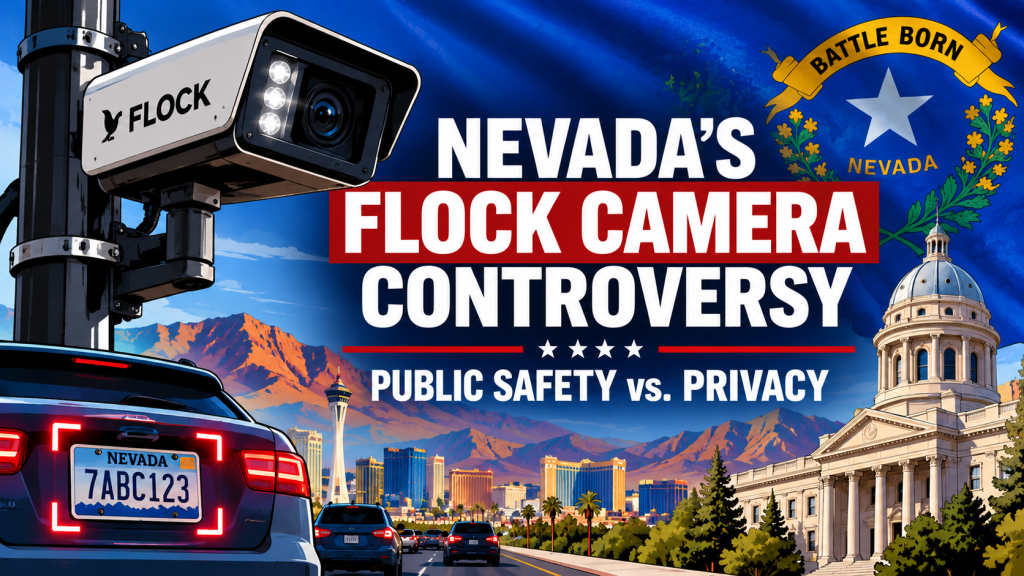
Hundreds of automated license-plate readers are already operating across Nevada.
The statewide rules governing them are another matter.
That gap has turned what was largely a law-enforcement technology issue into a debate involving the Nevada Legislature, civil-liberties organizations, police departments and now the governor’s race between Republican Gov. Joe Lombardo and Democratic Attorney General Aaron Ford.
The technology itself is relatively straightforward.
Automated license-plate readers photograph vehicles passing a fixed location and record information such as a license plate, vehicle characteristics, location and time.
Flock Safety’s system then allows authorized law-enforcement users to search information across a broader network.
For police, that can be extremely useful.
If officers are searching for a stolen vehicle, a kidnapping suspect or a car associated with another serious crime, knowing where that vehicle was recently observed can dramatically narrow an investigation.
Police officials have publicly defended the technology on precisely those grounds.
But the same capability produces the privacy question Nevada is only now seriously confronting.
A database capable of showing where a suspect’s vehicle traveled is also a database capable of showing where somebody who is not suspected of a crime traveled.
Who gets to search it?
What justification must an officer provide?
How long is the information retained?
Can another Nevada department search it?
Can an agency in another state?
Can a federal agency?
Are searches independently audited?
And what happens when someone violates the rules?
Nevada currently lacks a comprehensive statewide ALPR statute answering those questions.
That would be less consequential if the technology were still experimental.
It isn’t.
Previous reporting documented at least 200 Flock cameras in Clark County and at least 180 in Washoe County, with systems operating in several Nevada jurisdictions.
The state therefore finds itself debating regulation after substantial deployment has already occurred.
The Legislature appears increasingly likely to address that.
Nevada’s interim Judiciary Committee voted in August to request legislation for the 2027 session addressing automated license-plate readers.
Ideas discussed include requiring written agency policies, training authorized users, conducting independent compliance audits and requiring annual reports to the attorney general, governor and Legislature.
Those would create a statewide accountability structure where Nevada currently has a patchwork of agency practices.
Some critics say that is insufficient.
Assemblymember Selena La Rue Hatch has indicated she wants legislation prohibiting ALPR systems altogether.
The ACLU of Nevada has similarly questioned whether regulation can adequately address the privacy problems created by a network capable of collecting enormous quantities of vehicle-location information.
Law enforcement presents the competing consideration.
A prohibition would not merely eliminate theoretical surveillance capabilities. It would also remove an investigative tool police say helps them identify vehicles associated with crimes more quickly.
That tradeoff deserves more scrutiny than either “the cameras keep us safe” or “the cameras are mass surveillance.”
Evidence matters.
Nevada agencies using the systems should be able to provide lawmakers with statistics showing how often ALPR searches contributed materially to investigations, arrests, stolen-vehicle recoveries or missing-person cases.
They should also provide audit information showing how often searches violated policy, whether outside agencies accessed Nevada-generated information and what disciplinary mechanisms exist for unauthorized searches.
Privacy advocates should likewise identify the specific technical capabilities they believe cannot be adequately controlled through regulation.
That would allow lawmakers to distinguish between risks that can potentially be mitigated and risks inherent in the technology itself.
The governor’s race adds another dimension.
Ford has said Nevada needs stringent safeguards and that he does not support continued Flock use until protections are established. His campaign has also indicated that he is open to considering an outright ban.
Lombardo’s position deserves particular attention because he previously led LVMPD, one of the Nevada agencies that adopted the technology.
But the issue is larger than either candidate.
Whatever Nevada decides in 2027 could remain state policy through multiple administrations.
That makes several principles worth establishing before lawmakers choose between regulation and prohibition.
First, searches should be connected to legitimate law-enforcement purposes and auditable.
Second, Nevada should know exactly how long vehicle information is retained.
Third, policymakers should know which agencies — Nevada, out-of-state or federal — can access information collected by Nevada cameras.
Fourth, residents should know what happens when someone accesses the system improperly.
Finally, lawmakers should determine whether those protections can actually be enforced technically rather than merely written into agency policy.
The most important fact in this debate may ultimately be the simplest.
Nevada is not deciding whether to introduce automated license-plate readers.
Nevada already introduced them.
The state is deciding whether the rules that should arguably have accompanied their deployment will now be created after the fact.
That deserves a serious legislative debate based on documented investigative benefits, documented privacy risks and enforceable safeguards — not merely campaign-season arguments over who is tougher on crime or more protective of privacy.
Manual-review flag: Avoid stating that Flock or Nevada law enforcement “tracks everyone,” illegally surveils Nevadans, sells Nevada police data, or systematically shares information with immigration authorities unless a specific claim is supported by contracts, audit records, agency disclosures or court findings. Likewise, do not state that ALPR systems prevent or solve crimes generally without evidence identifying their actual contribution to investigations. The constitutional status of particular ALPR practices may also depend on facts and remains subject to legal dispute. Nevada Current